The global packaging industry continues to grow rapidly due to increasing demand from beverage, pharmaceutical, food, personal care, and cosmetic sectors. Modern manufacturers require packaging solutions that offer durability, clarity, lightweight performance, and cost efficiency while supporting high-speed production.
One of the most important technologies behind modern plastic packaging is precision PET bottle mould engineering. Advanced PET bottle mould systems help manufacturers produce bottles with accurate dimensions, consistent wall thickness, superior transparency, and reliable strength.
With modern CAD/CAM design systems, CNC machining, EDM technology, precision cooling channels, and automated blow moulding systems, PET bottle mould manufacturing has become highly advanced and capable of supporting large-scale industrial production.
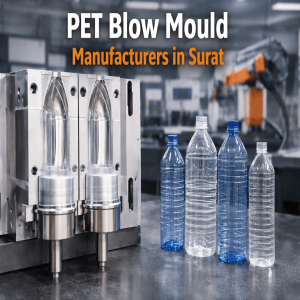
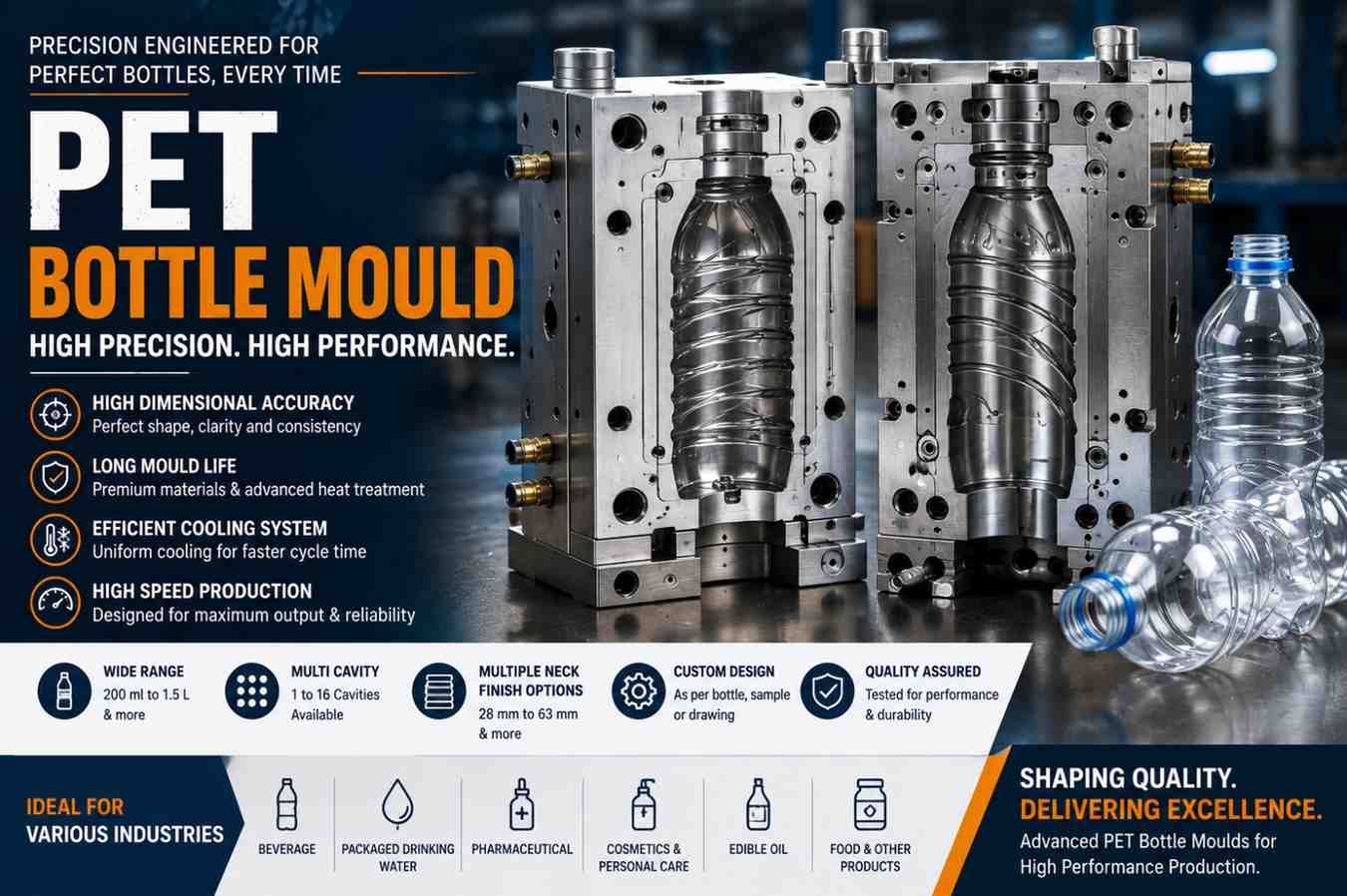
A PET bottle mould is a high-precision metallic cavity system used to convert heated PET preforms into finished plastic bottles through stretch blow moulding technology.
During the process:
PET preforms are heated to the required temperature.
A stretch rod elongates the preform.
High-pressure compressed air expands the material inside the mould cavity.
The bottle takes the exact shape of the mould.
Cooling channels rapidly solidify the bottle.
This process creates bottles with:
High clarity
Excellent strength
Uniform wall thickness
Accurate neck dimensions
Consistent surface finish
Precision mould engineering directly affects the quality and performance of the final packaging product.
Packaging industries demand consistent bottle quality because even minor dimensional variations can affect:
Filling operations
Cap fitting
Label alignment
Product appearance
Pressure resistance
Shelf stability
Precision moulds ensure manufacturers achieve:
Uniform bottle shape
Smooth surface finish
Consistent bottle weight
Accurate neck threading
High production efficiency
Advanced mould systems also help reduce:
Bottle defects
Material wastage
Production downtime
Cooling inconsistencies
Surface imperfections
PET bottle mould technology supports a wide range of industrial applications.
Manufacturers produce:
Water bottles
Carbonated drink bottles
Juice bottles
Energy drink packaging
Edible oil containers
The beverage sector requires lightweight yet strong bottles capable of handling internal pressure.
PET packaging is widely used for:
Syrup bottles
Supplement containers
Medical liquid packaging
Sanitizer bottles
Precision is critical for maintaining sealing performance and hygiene standards.
Manufacturers use PET bottles for:
Shampoo bottles
Lotion containers
Cosmetic packaging
Personal care products
These applications demand attractive appearance and superior transparency.
PET containers are commonly used for:
Cooking oils
Sauces
Food storage packaging
Condiment bottles
Different production requirements require different mould configurations.
These are the most widely used mould systems.
In this process:
PET preforms are manufactured separately.
Preforms are reheated.
Bottles are blow moulded in a second stage.
These systems are ideal for:
High-speed production
Beverage packaging
Large-scale bottling operations
Single-stage systems combine injection moulding and bottle blowing in one machine.
These moulds are commonly used for:
Pharmaceutical packaging
Premium cosmetic bottles
Specialized packaging applications
Heat-set moulds are designed for hot-fill applications such as:
Juice bottles
Tea packaging
Heat-resistant containers
Used for regular bottle designs including:
Round bottles
Square bottles
Standard commercial packaging
The material used for mould manufacturing significantly affects performance and durability.
Advantages include:
Lightweight construction
Faster cooling
High thermal conductivity
Improved production speed
These moulds offer:
High durability
Corrosion resistance
Long operational life
Better performance in high-volume production
High-grade steel components improve:
Wear resistance
Dimensional stability
Long-term accuracy
A PET bottle mould consists of several precision-engineered components.
The mould cavity determines the bottle’s final shape and dimensions.
The base plate helps create stable and accurate bottle bottoms.
Internal water channels rapidly remove heat and improve cycle times.
Micro vents allow trapped air to escape during blow moulding.
These ensure accurate bottle threading and cap compatibility.
Every component is carefully engineered to maintain consistent production quality.
Modern mould systems support rapid manufacturing cycles suitable for mass production.
Precision mould engineering improves transparency and appearance.
Consistent material distribution improves bottle strength and durability.
Logos, measurement markings, and custom textures can be integrated directly into the bottle design.
Optimized mould designs improve PET material utilization.
Advanced manufacturing processes increase mould durability and operational reliability.
Manufacturers benefit from:
Faster cycle times
Reduced defects
Lower maintenance costs
Better output consistency
Modern PET bottle mould manufacturing relies on advanced precision engineering technologies.
CNC systems provide:
Accurate cavity machining
Tight dimensional tolerances
Better repeatability
Complex geometry creation
Electrical Discharge Machining (EDM) helps create:
Fine details
Sharp cavity features
Precision cooling paths
Intricate bottle designs
Digital design software allows engineers to optimize:
Bottle geometry
Cooling efficiency
Material distribution
Production performance
India has become a strong global supplier of PET bottle mould systems due to:
Advanced engineering capabilities
Skilled technical workforce
Competitive manufacturing costs
Strong customization support
Export-oriented production infrastructure
Compliance with international quality standards
Indian manufacturers now supply mould systems to packaging companies across global markets.
Selecting the right mould system is essential for maintaining production efficiency and packaging quality.
High-volume production requires durable mould systems with optimized cooling.
Complex bottle shapes demand advanced mould engineering.
Mould systems must match blow moulding machine specifications.
The mould material affects cooling performance, durability, and maintenance.
Reliable manufacturers should provide strong after-sales support and maintenance guidance.
The packaging industry continues to evolve with modern manufacturing innovations.
Key trends include:
Lightweight bottle design
Sustainable packaging solutions
High-speed automation
Smart manufacturing systems
Energy-efficient mould cooling
Recyclable packaging technologies
AI-assisted production optimization
Manufacturers adopting advanced mould engineering technologies can improve both productivity and packaging quality.
Modern mould systems help manufacturers reduce operational costs through:
Faster production cycles
Reduced PET consumption
Lower rejection rates
Improved cooling performance
Reduced maintenance downtime
Long mould service life
These advantages make precision mould engineering highly valuable for large-scale packaging operations.
Precision PET bottle moulds play a critical role in modern packaging manufacturing by supporting high-speed production, superior bottle clarity, consistent dimensions, and reliable performance.
Advanced technologies such as CNC machining, EDM processing, CAD/CAM design systems, and precision cooling engineering have significantly improved mould accuracy and operational efficiency.
From beverage and pharmaceutical industries to cosmetics and food packaging sectors, manufacturers increasingly rely on precision mould engineering to achieve high-quality packaging with cost-effective production.
Businesses investing in advanced PET bottle mould systems benefit from better productivity, reduced material waste, improved packaging consistency, and long-term manufacturing efficiency.