Modern manufacturing depends on components that are accurate, consistent, and produced according to exact technical requirements. From flat surfaces and complex pockets to intricate profiles and multi-face components, manufacturers often need a machining process that can handle a wide range of geometries with precision.
CNC Milling Services provide a reliable solution for producing complex engineering components from different materials. Using computer-controlled machining centres, CNC milling can support prototype development, custom component manufacturing, and large-scale production while maintaining dimensional accuracy and repeatable quality.
CNC Milling Services use computer-controlled rotating cutting tools to remove material and create precise shapes, surfaces, pockets, slots, and complex component features.
The process is widely used when a component requires flat faces, irregular geometry, detailed contours, or features on multiple sides. CNC programming controls the movement of the cutting tools, helping manufacturers produce components according to the required drawings and specifications.
CNC milling can be used for simple parts such as mounting plates and brackets as well as more complex applications, including mould cavities, tooling inserts, housings, and precision engineering components.
CNC milling works by using programmed machine movements and rotating cutting tools to remove material from a workpiece.
The machining process typically begins with a component drawing or CAD file. The design is reviewed to understand the required geometry, dimensions, tolerances, and machining features.
A suitable machining strategy is then planned. The machine and cutting tools are selected according to the component material and design requirements. CNC programming controls the machining operation to create the required surfaces and features.
Careful planning before machining helps improve efficiency, maintain accuracy, and reduce unnecessary production issues.
CNC Milling Services are suitable when a component requires flat surfaces, pockets, slots, complex profiles, or machining across multiple faces.
Milling is especially useful for components that cannot be efficiently produced through rotational machining processes. Parts with irregular shapes, multiple surfaces, or detailed 3D features can benefit from CNC milling.
Typical applications include:
The right machining process depends on the geometry and functional requirements of the component.
CNC milling can perform several different machining operations depending on the required component geometry.
Face milling is used to create flat and smooth surfaces on components that need accurate mating or mounting faces.
Plain milling is useful for machining broad flat surfaces and engineering structures.
Angular milling can produce chamfers, angled slots, and features positioned at specific angles.
Form milling supports complex contours, curved surfaces, and specialised profiles.
Pocket milling is commonly used to create cavities, recesses, and internal features in housings, moulds, and fixtures.
Slot milling is used for keyways, grooves, channels, and accurately positioned slots.
Profile milling allows external and internal contours to be machined directly according to programmed component geometry.
These operations can be combined to manufacture highly specialised components from a single drawing or CAD model.
The main difference between 3-axis, 4-axis, and 5-axis milling is the number of directions and movements available for machining a component.
3-axis CNC milling is widely used for flat components, plates, brackets, fixtures, and many standard precision machining applications. It provides an efficient solution for a large range of industrial components.
4-axis CNC milling allows additional movement and indexing, making it easier to machine features on multiple faces without repeated manual repositioning.
5-axis CNC milling is designed for highly complex geometries, compound angles, advanced mould work, and components that require machining access from multiple directions.
Choosing the correct axis configuration can help improve accuracy, reduce setups, and increase manufacturing efficiency.
CNC milling uses a rotating cutting tool, while CNC turning generally uses a rotating workpiece.
Milling is best suited to flat, complex, and irregular shapes. Turning is generally more appropriate for cylindrical and rotational components such as shafts, bushes, sleeves, and pins.
If a component includes pockets, slots, multiple faces, or complex three-dimensional geometry, milling may be the better choice.
Some engineering components require both turning and milling operations. In these cases, the manufacturing strategy should be planned according to the complete geometry and functional requirements of the part.
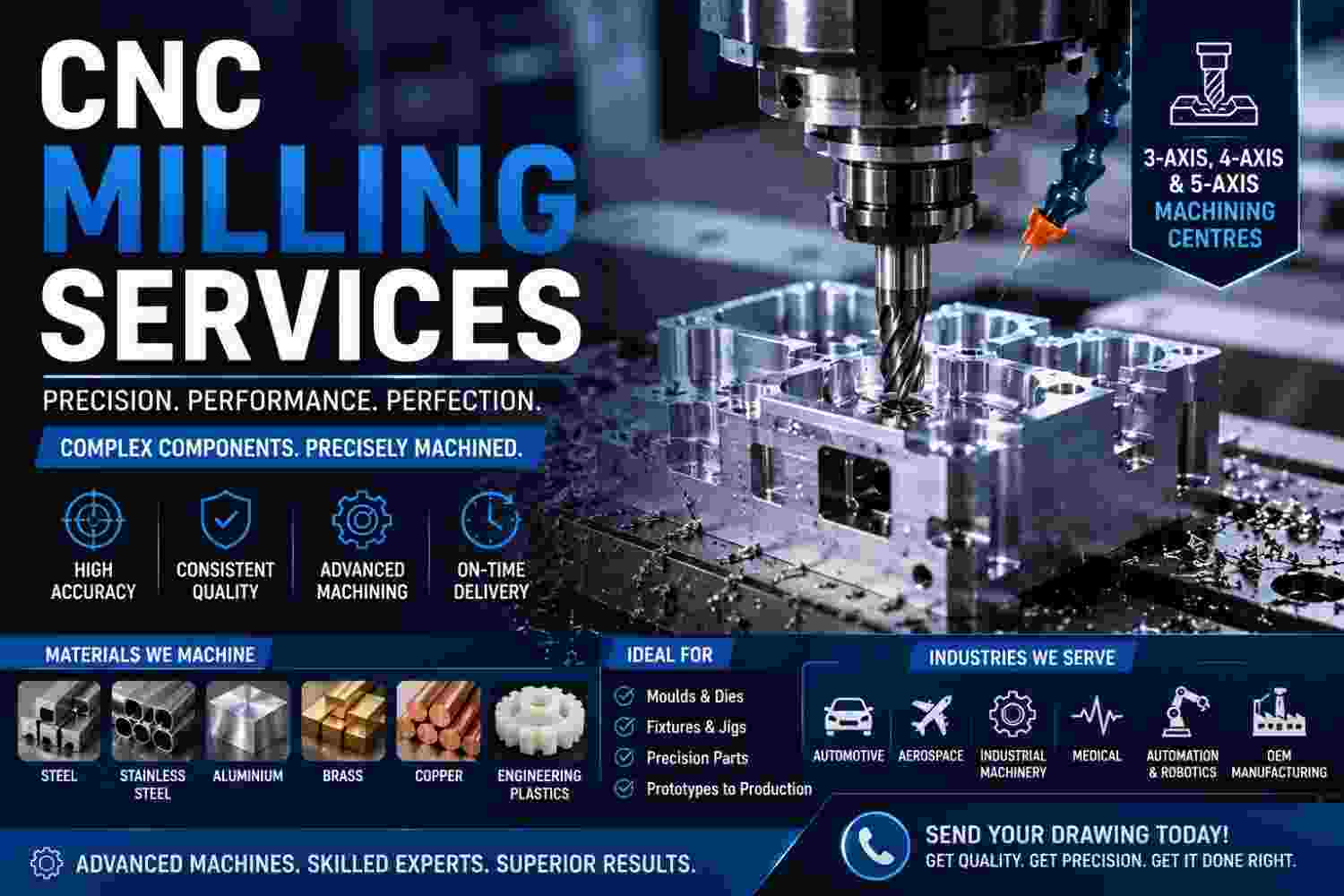
CNC milling can process a wide range of metals and engineering plastics.
Common materials include:
Different materials require different machining approaches. Tool selection, spindle speed, feed rate, and coolant strategy must be considered carefully to achieve the required quality.
Understanding how each material behaves during machining is an important part of maintaining surface finish, accuracy, and process consistency.
Tight tolerances are important because many engineering components must fit, function, or assemble precisely with other parts.
Small dimensional variations can affect the performance of a mechanical assembly. This is why the machining process must follow the requirements specified in the component drawing.
CNC Milling Services can support demanding dimensional requirements through controlled programming, suitable machining strategies, and inspection processes.
Accuracy is particularly important for tooling components, moulds, precision assemblies, industrial machinery, and specialised engineering applications.
The required tolerance should always be considered during the planning stage because tighter requirements can influence machining time, inspection needs, and production methods.
CNC Milling Services offer high flexibility for manufacturing components with different shapes, sizes, and levels of complexity.
Key benefits include:
These benefits make CNC milling one of the most widely used processes in precision and industrial manufacturing.
CNC milling is used across many industries where accurate and reliable components are required.
Common applications can be found in:
The flexibility of CNC milling allows manufacturers to support different industries while adapting the machining process to specific material and design requirements.
CNC milling can support both early-stage prototypes and larger production batches.
For prototypes, CNC machining allows manufacturers to produce components directly from technical drawings or CAD data. This can help evaluate a design before moving into larger-scale production.
For production requirements, programmed machining processes help maintain repeatability across multiple components.
The same attention to dimensional accuracy, surface finish, and inspection should be maintained regardless of whether the requirement is for a single component or a larger production quantity.
A well-planned machining process helps support consistent quality throughout different stages of manufacturing.
Before beginning a CNC milling project, the component drawing, material, tolerance requirements, geometry, production quantity, and surface finish expectations should be reviewed.
A detailed assessment can help identify the most suitable machining strategy. Complex features may require specific machine configurations, specialised tooling, or multiple machining operations.
It is also important to consider whether the component requires milling alone or a combination of manufacturing processes.
Clear technical information at the beginning of a project can help improve production planning and reduce uncertainty during machining.
CNC Milling Services are important because they provide the flexibility and precision needed to manufacture components with complex shapes, detailed features, and demanding dimensional requirements.
From flat plates and brackets to mould cavities, intricate profiles, and multi-face engineering components, CNC milling supports a wide range of manufacturing applications.
The combination of advanced machining centres, CNC programming, suitable tooling, and proper inspection helps manufacturers achieve consistent results.
For any precision manufacturing requirement, the goal is to produce a component that matches the intended design and performs reliably in its final application. CNC milling remains one of the most effective machining processes for achieving that objective.