Modern manufacturing often requires components with tight tolerances, intricate profiles, sharp internal corners, and highly consistent dimensions. Conventional machining methods may not always be suitable for such demanding requirements, especially when working with hardened or electrically conductive materials.
Modern manufacturing often requires components with tight tolerances, intricate profiles, sharp internal corners, and highly consistent dimensions. Conventional machining methods may not always be suitable for such demanding requirements, especially when working with hardened or electrically conductive materials.
CNC Wirecut EDM Services provide a precision-focused machining solution for complex components, tooling parts, mould inserts, and specialised engineering applications. By using controlled electrical spark erosion and a thin wire, this process can achieve shapes and levels of accuracy that are difficult to produce with conventional cutting methods.
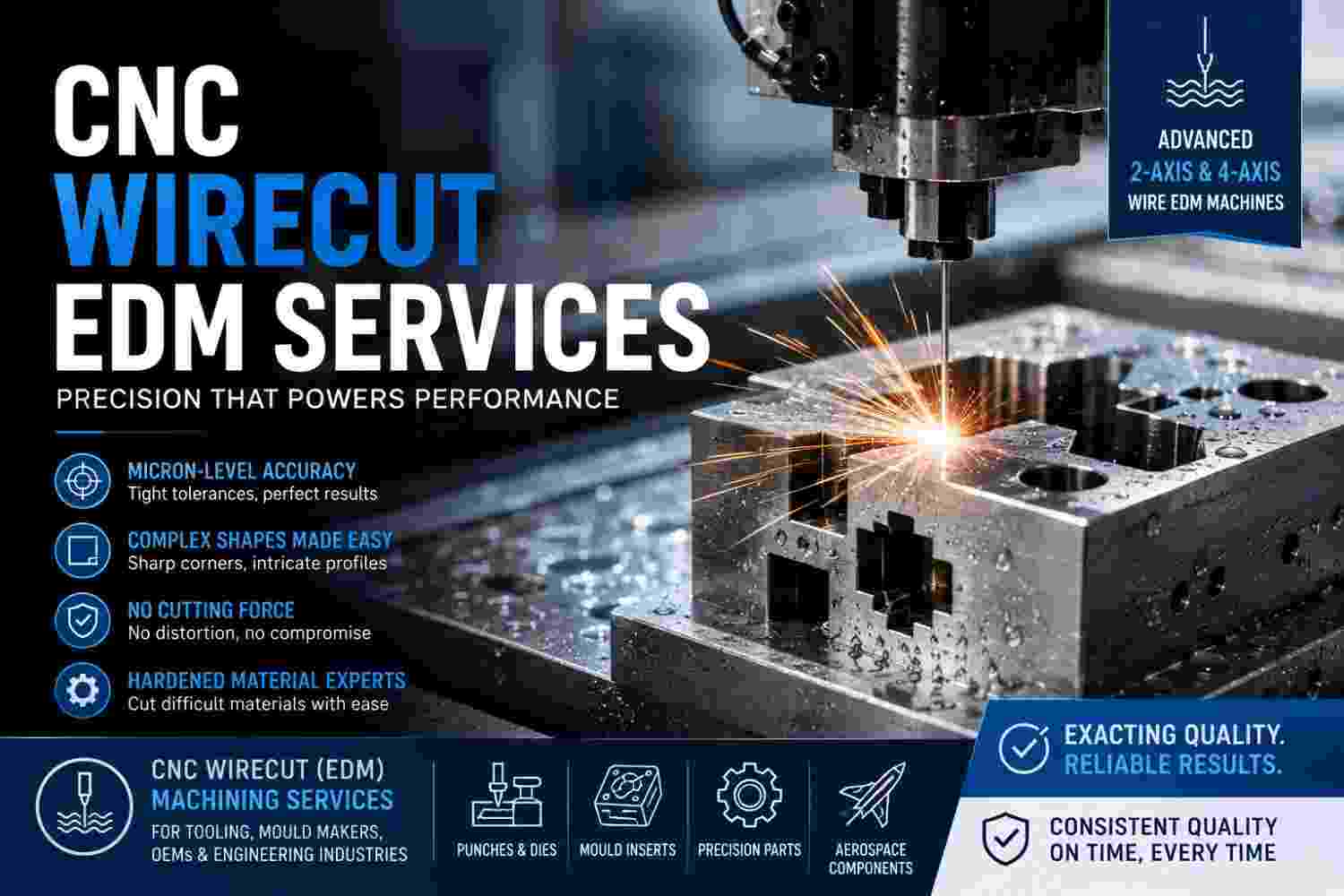
CNC Wirecut EDM Services use a thin electrically charged wire and controlled spark erosion to cut complex shapes in electrically conductive materials.
Wirecut EDM is a non-contact machining process. Unlike traditional cutting methods, there is no physical cutting tool pressing against the workpiece. Instead, the process uses electrical discharges to remove material with precision.
This makes the process especially useful when components require intricate geometry, narrow slots, sharp internal corners, or complex contours. Since there is no direct cutting force, the risk of mechanical distortion can also be reduced.
The process is widely used for precision tooling, engineering components, dies, mould inserts, and other applications where dimensional accuracy is essential.
CNC Wirecut EDM works by guiding an electrically charged wire through conductive material while controlled electrical sparks gradually remove the material.
The wire follows a programmed path based on the required component geometry. Modern CNC programming helps control the movement of the wire and supports repeatable machining across multiple components.
Because the process does not rely on a conventional cutting edge, material hardness is not the same limitation it can be with traditional machining. Hardened materials and complex profiles can therefore be processed with a high level of control.
The quality of the final component depends on factors such as the required tolerance, material, geometry, machining parameters, and desired surface finish.
CNC Wirecut EDM Services are a suitable option when a component requires complex profiles, sharp internal corners, tight tolerances, or machining of hardened conductive materials.
Some parts simply cannot be produced efficiently with conventional milling. For example, a milling cutter has a physical tool radius that can make perfectly sharp internal corners difficult to achieve.
Wirecut EDM is particularly useful when:
By selecting the right machining process at the beginning of a project, manufacturers can reduce unnecessary setups and improve the efficiency of complex component production.
2-axis Wirecut EDM is generally used for straight vertical profiles, while 4-axis Wirecut EDM can create angled or tapered shapes.
A standard 2-axis process is suitable for many common tooling components. It can be used for punches, dies, plates, slots, inserts, and other parts where the profile remains consistent through the component depth.
A 4-axis or taper Wirecut EDM process provides additional flexibility. It can be used when a component requires an angled profile, taper, or specialised geometry.
The appropriate method depends on the design requirements of the part. Reviewing the drawing or CAD data before machining helps determine which process is best suited to the required geometry.
Slow Wire EDM is commonly used when superior surface finish and tighter dimensional accuracy are important.
For critical components, surface quality and dimensional control can be just as important as the overall shape. Slow Wire EDM is designed for applications where these requirements are especially demanding.
This method may require more machining time, but it can provide improved surface finish and precision. In some applications, the finish achieved through the process may reduce the need for additional machining operations.
It is often selected for high-precision tooling and components where small dimensional variations can affect the performance of the final product.
Fast Wire EDM can be a practical option for engineering components and production requirements where cost efficiency is an important consideration.
Not every component requires an ultra-fine finish or the highest possible level of precision. For general engineering applications and certain production runs, fast Wire EDM can offer an efficient machining approach.
The right choice should depend on the component's function, required tolerance, finish expectations, production quantity, and overall manufacturing requirements.
A proper evaluation of the part before production can help ensure that the selected process matches both technical and commercial needs.
Wirecut EDM can process electrically conductive materials, including various steels, alloys, carbide, aluminium, copper, brass, and other metals.
One of the key advantages of the process is that material hardness does not create the same machining limitations found with conventional cutting methods.
Commonly processed materials can include:
The most important requirement is electrical conductivity. Before machining an unfamiliar material, its suitability should be reviewed along with the component's geometry and required tolerances.
Sharp internal corners are important because many tooling and engineering components require precise geometry that conventional cutting tools may not be able to produce.
Traditional milling tools have a physical diameter, which naturally creates a radius when machining internal corners. This can become a problem when the component design requires a sharper corner.
Wirecut EDM does not have the same tool-radius limitation. The programmed wire path allows complex profiles and precise internal features to be created.
This capability is especially valuable in punches, dies, mould inserts, gauges, fixtures, and other specialised tooling components.
CNC Wirecut EDM Services offer high precision, complex profile capability, sharp internal corners, reduced mechanical force, and consistent repeatability.
The process offers several advantages for complex manufacturing requirements:
These advantages make Wirecut EDM a valuable option when conventional machining methods cannot reliably achieve the required result.
Wirecut EDM uses electrical spark erosion without direct cutting contact, while conventional milling uses a physical cutting tool.
Both processes are important in modern manufacturing, but they are suited to different requirements. Conventional milling is highly versatile and can machine many materials, including non-conductive materials.
Wirecut EDM, on the other hand, is designed for electrically conductive materials and is particularly effective for intricate profiles, hardened materials, and sharp internal corners.
If a component has complex geometry that conventional milling cannot easily produce, Wire EDM may be the more suitable choice. Reviewing the part design and manufacturing requirements is the best way to determine the correct process.
Wirecut EDM is useful in industries where precision, complex geometry, and dimensional consistency are essential.
Applications can be found in tool and die manufacturing, mould production, automotive tooling, aerospace components, medical device manufacturing, precision engineering, industrial automation, extrusion tooling, forming tools, and OEM production.
The process can support both prototype development and repeat production. This flexibility allows manufacturers to use precision EDM machining throughout different stages of a product or tooling project.
Start by reviewing the component drawing, CAD file, material, tolerance requirements, and expected surface finish.
A detailed technical review helps identify the most suitable machining approach before production begins. The geometry should be examined carefully, along with features that may require special attention.
Important information may include material type, component thickness, required tolerance, production quantity, and surface finish expectations.
Whether the requirement is a single prototype, a specialised tooling component, or a larger production batch, selecting the right process is essential for achieving reliable results.
CNC Wirecut EDM Services are ideal for complex components because they combine precision, flexibility, repeatability, and the ability to machine challenging conductive materials.
When a component demands sharp geometry, intricate contours, tight tolerances, or hardened material machining, the right manufacturing process can make a significant difference.
Wirecut EDM provides a practical solution for many of these challenges. With proper CNC programming, careful inspection, and a well-planned machining strategy, complex components can be produced with the accuracy and consistency required for demanding engineering applications.
For precision manufacturing, the goal is not simply to cut a component. It is to achieve the exact geometry, dimensional control, and finish required for the application—and Wirecut EDM remains an important process for making that possible.