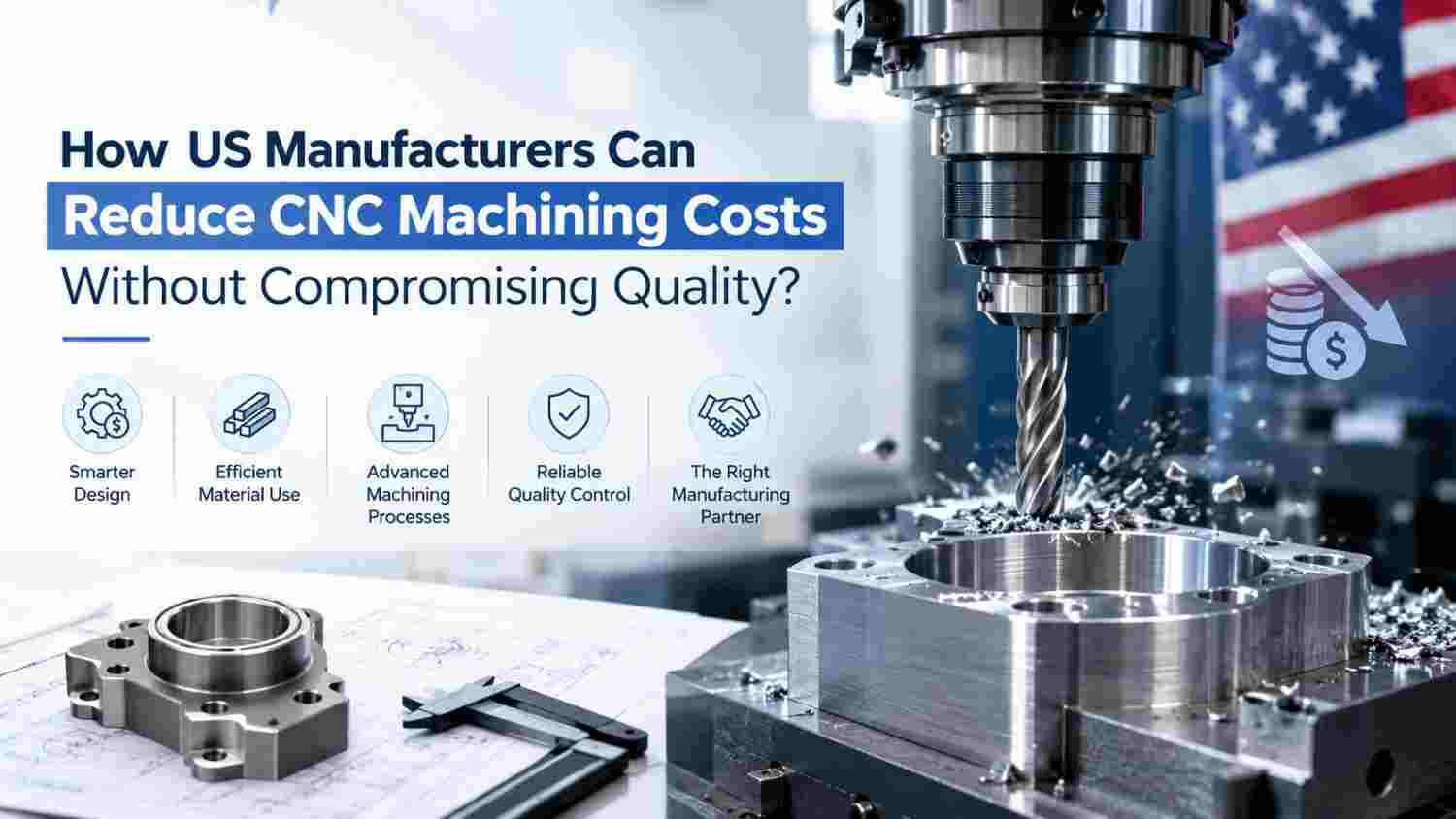
Reducing manufacturing costs is an important goal for US manufacturers, OEMs, engineering companies, and product developers. However, lowering the cost of a machined component should never mean compromising dimensional accuracy, material quality, surface finish, or production reliability.
For companies sourcing components internationally, the right manufacturing partner can help control costs through efficient machining, material utilization, process planning, quality inspection, and production management.
So, how can US manufacturers reduce CNC machining costs while maintaining the quality their applications require?
The answer is to optimize the complete manufacturing process rather than simply choosing the supplier offering the lowest quotation.
CNC machining costs depend on several factors, including material, component geometry, machining time, tolerances, surface finish, tooling, production quantity, inspection requirements, and post-machining operations.
A component with a simple geometry may require significantly less machining time than a complex part with deep cavities, tight tolerances, multiple setups, or difficult-to-machine materials.
Other factors that can influence the final cost include:
Understanding these factors helps manufacturers identify where savings can be achieved without reducing the required quality level.
Yes. Design optimization can significantly reduce machining time, material consumption, and tooling requirements.
Manufacturers should review a component's design before production begins. Features that require complicated setups, excessive material removal, or specialized tooling can increase manufacturing costs.
Design-for-manufacturing considerations may include:
This does not mean changing the functional requirements of a component. Instead, the objective is to identify opportunities to make the component easier and more efficient to manufacture.
Outsourcing can be cost-effective when a manufacturer selects an experienced supplier with the right machining capabilities and quality-control systems.
Maintaining every machining capability in-house can require significant investment in CNC equipment, tooling, programming, maintenance, skilled operators, inspection equipment, and facility infrastructure.
For some manufacturers, outsourcing selected components can provide access to specialized manufacturing capabilities without requiring the same level of capital investment.
A reliable CNC Machining Services partner can also support prototype development, small-batch production, repeat manufacturing, and larger production requirements depending on the supplier's capabilities.
Production quantity has a major effect on the cost per component.
Prototype and low-volume production often carry higher per-piece costs because programming, setup, tooling, and inspection expenses are distributed across fewer parts.
As production quantities increase, these initial costs can be spread over a larger number of components.
Manufacturers should therefore provide accurate expected quantities when requesting quotations. A supplier may be able to recommend a more efficient production strategy when it understands whether the requirement is for:
For overseas buyers, discussing expected future volumes with the supplier can also help with production planning and cost optimization.
Wire EDM can be highly useful when components require intricate profiles, narrow slots, sharp internal corners, or high dimensional accuracy.
Unlike conventional cutting methods, Wire EDM uses a controlled electrical discharge process to cut electrically conductive materials. This makes it particularly useful for dies, punches, tooling, precision components, and complex profiles.
Using the appropriate manufacturing process is important. Trying to produce a complex component using a less suitable machining method may increase machining time, tooling requirements, and finishing work.
For components requiring accurate profiles or specialized cutting, CNC Wirecut EDM Services can therefore be an important part of an efficient manufacturing strategy.
Material selection and machining strategy can have a direct effect on manufacturing cost.
When a component requires substantial material removal, the difference between the raw material size and final component size can become significant.
Manufacturers can work with their machining supplier to evaluate:
For production components, optimizing raw material procurement and machining operations can produce meaningful savings over time.
However, material selection should always be based on the component's operating requirements. Choosing a cheaper material that does not meet the required mechanical, thermal, corrosion, or wear characteristics can create much higher costs later.
Quality inspection adds a manufacturing activity, but eliminating necessary inspection is not a reliable way to reduce costs.
For precision components, dimensional errors can lead to assembly problems, rejected parts, production delays, and expensive rework.
A suitable inspection process helps identify problems before components move further into the manufacturing or assembly process.
Depending on the component, inspection may involve checking:
The goal is not simply to inspect more. It is to establish the right inspection process according to the component's function and quality requirements.
International sourcing can provide cost advantages, but successful outsourcing requires clear communication and proper production planning.
US manufacturers should provide the supplier with accurate technical information, including:
Clear documentation reduces the risk of misunderstandings and minimizes costly revisions during production.
It is also useful to evaluate the supplier's ability to manage the complete manufacturing process rather than focusing only on the quoted piece price.
The lowest quotation does not always represent the lowest overall manufacturing cost.
A supplier with limited capabilities may initially offer a lower price but could create additional expenses through inconsistent quality, delays, rejected components, rework, or outsourcing of critical operations.
A capable manufacturing partner can potentially manage several stages under one production system, reducing unnecessary coordination between multiple vendors.
For example, a supplier offering CNC machining, Wire EDM, tooling, inspection, and related manufacturing services can provide a more streamlined production workflow for suitable projects.
This can be especially valuable for US manufacturers looking for a long-term outsourcing partner rather than a one-time supplier.
Yes. Contract manufacturing can allow companies to outsource selected production activities to a specialized manufacturing partner.
Instead of investing in every machine and manufacturing process internally, a company can work with an experienced supplier according to its technical specifications and production requirements.
This approach can be useful for:
A well-managed Contract Manufacturing arrangement can also provide flexibility when production volumes change.
Before choosing a supplier, US manufacturers should evaluate more than price.
Important factors include:
Requesting samples or reviewing previous work can also help a buyer understand whether the supplier is suitable for the required application.
The best approach is to optimize the entire manufacturing process rather than focusing only on the hourly machining rate or quoted component price.
US manufacturers can reduce costs by combining:
Working with an experienced manufacturing partner can make this process much easier because the supplier can identify practical opportunities for improving production efficiency.
Reducing CNC machining costs does not have to mean accepting lower quality. The most effective savings usually come from better design decisions, efficient process planning, appropriate machining technology, optimized material usage, and selecting the right manufacturing partner.
For US manufacturers, international outsourcing can provide access to specialized machining and production capabilities while reducing the need for significant in-house investment.
The key is to evaluate the complete manufacturing process—not simply compare the lowest price per component. A supplier capable of supporting precision machining, Wire EDM, tooling, inspection, and contract manufacturing can provide a more efficient solution for companies looking for reliable long-term production support.