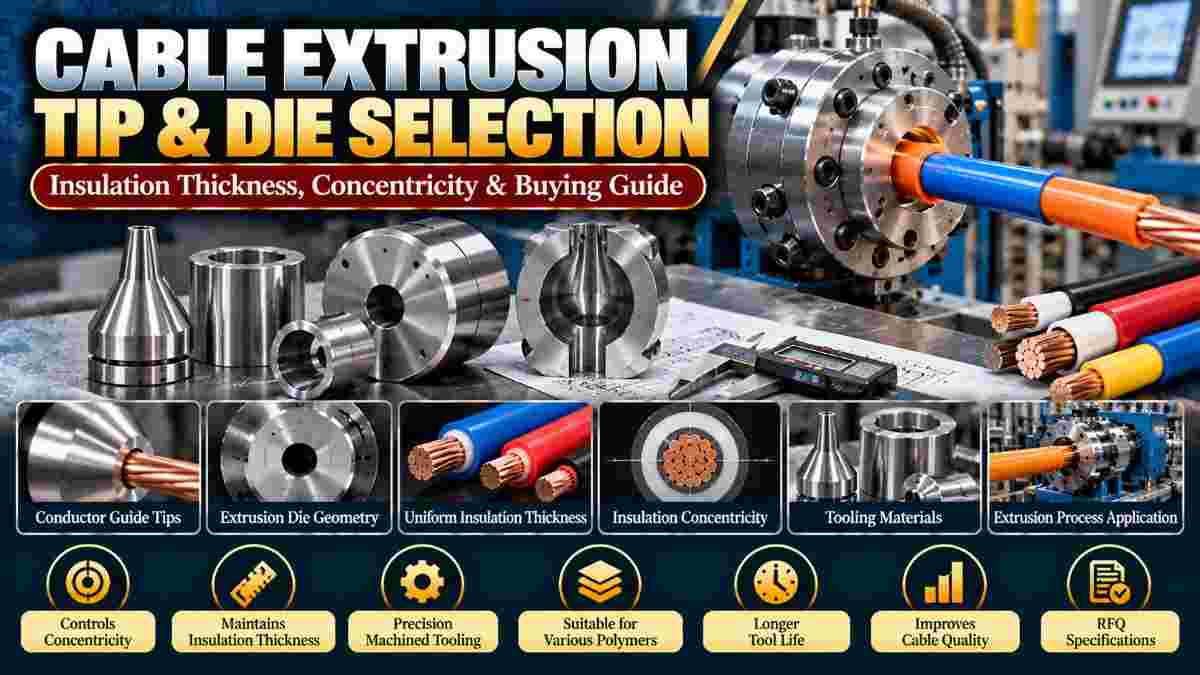
Are you facing uneven insulation thickness, poor cable concentricity, or excessive material wastage during wire and cable manufacturing? Incorrect extrusion tooling may contribute to these production problems.
Cable extrusion tip and die selection depends on conductor diameter, required insulation thickness, finished cable diameter, polymer type, tooling geometry, alignment, and operating conditions.
The right tooling combination helps guide the conductor and control polymer flow during cable insulation or sheathing.
Parekh Wire Cut offers precision-engineered cable extrusion tips and dies for industrial manufacturing applications.
Cable extrusion tips and dies are precision tooling components used to guide conductors and shape molten insulation material during wire and cable production.
The extrusion tip guides the conductor through the crosshead, while the die helps control the shape and dimensions of the polymer coating.
Common applications include:
Electrical power cables.
Automotive wiring.
Communication cables.
Control cables.
Industrial insulated wires.
Specialty cable manufacturing.
Explore Tip & Die Cable Extrusion Dies for product information.
Correct tip and die selection helps maintain conductor alignment and suitable polymer distribution, supporting more uniform insulation thickness.
Incorrect tooling geometry can contribute to:
Uneven insulation walls.
Excessive polymer consumption.
Poor cable concentricity.
Surface defects.
Dimensional variation.
Increased production scrap.
Tooling must work together with appropriate extrusion settings and line alignment.
An extrusion tip primarily guides and centers the conductor, while an extrusion die shapes the polymer coating and helps determine the finished cable dimensions.
The tip and die perform complementary functions.
A correctly manufactured die cannot fully compensate for a misaligned conductor guide.
Similarly, precise conductor positioning does not guarantee suitable coating dimensions if the die geometry or process settings are incorrect.
Conductor diameter determines the required guide-tip opening and influences the dimensions of the complete tooling arrangement.
Important factors include:
Nominal conductor diameter.
Maximum conductor diameter.
Stranded or solid construction.
Conductor surface condition.
Required guiding clearance.
Finished insulated diameter.
Stranded conductors may require additional consideration of dimensional variation and surface characteristics.
Provide actual conductor specifications before ordering tooling.
Insulation concentricity is controlled through accurate conductor guidance, properly aligned tooling, balanced polymer flow, and suitable extrusion operating conditions.
Important checks include:
Verify conductor alignment.
Inspect the guide-tip opening.
Check tip and die positioning.
Confirm tooling dimensions.
Monitor polymer flow.
Measure finished cable eccentricity.
Adjust the extrusion process as required.
Concentricity should be verified using appropriate measurement procedures during production.
Pressure dies apply polymer around the conductor under pressure inside the tooling, while tubing dies form a polymer tube that is subsequently brought into contact with the conductor.
Pressure tooling may be selected for certain insulation applications requiring close material contact.
Tubing tooling can be suitable for applications where controlled drawdown of the polymer tube is required.
The appropriate method depends on the polymer, conductor, insulation design, and process requirements.
Tooling materials should be selected according to operating temperature, polymer characteristics, wear resistance, machining precision, and production conditions.
Common options include:
Tool steel.
Hardened steel.
Tungsten carbide.
Carbide-insert tooling.
Application-specific wear-resistant materials.
Higher-wear applications may benefit from suitable hard materials or inserts.
Confirm the material grade and treatment requirements with the manufacturer.
Polymer type influences tooling geometry, melt flow, processing temperature, and the required surface finish.
Common cable insulation and jacketing materials include:
PVC.
Polyethylene.
Cross-linked polyethylene systems.
Rubber compounds.
Other application-specific polymers.
Different compounds have different processing characteristics.
Tooling design should be evaluated alongside the material supplier's extrusion recommendations.
A suitable tooling surface finish helps support consistent polymer flow and reduces opportunities for material buildup or surface imperfections.
Inspect:
Die opening quality.
Internal surface condition.
Burrs.
Tool marks.
Edge damage.
Wear.
Dimensional consistency.
Surface finish requirements depend on the polymer, tooling design, and application.
Uneven insulation thickness can result from tip misalignment, incorrect die dimensions, unstable polymer flow, conductor movement, or inappropriate processing conditions.
Potential causes include:
Worn guide tips.
Incorrect tooling clearance.
Misaligned crosshead components.
Unstable line speed.
Uneven melt flow.
Conductor vibration.
Incorrect processing settings.
Inspect both the tooling and extrusion line before replacing components.
Extrusion tips and dies should be inspected or replaced when wear, damage, or dimensional changes prevent them from meeting approved production requirements.
Warning signs include:
Enlarged guide openings.
Surface scoring.
Damaged die edges.
Persistent concentricity problems.
Repeated coating defects.
Excessive material buildup.
Confirm that replacement components match the original tooling and machine configuration.
A complete quotation request should describe the conductor, insulation material, finished cable dimensions, tooling configuration, and operating conditions.
Use this checklist:
Conductor type and diameter.
Required insulation thickness.
Finished cable outside diameter.
Insulation or jacketing material.
Pressure or tubing extrusion method.
Extrusion machine and crosshead model.
Tip opening diameter.
Die opening dimensions.
Required tooling material.
Surface finish requirements.
Technical drawing or existing sample.
Quantity and delivery requirements.
Accurate specifications help manufacturers evaluate the required tooling geometry.
Parekh Wire Cut offers precision cable extrusion tips and dies for wire and cable manufacturing applications.
Its product page describes:
Precision conductor guide tips.
Cable extrusion dies.
Customized tooling geometry.
CNC machining processes.
Surface finishing.
Application-specific tooling requirements.
Explore Tip & Die Cable Extrusion Dies for additional product information.
Confirm the required dimensions, material specifications, manufacturing tolerances, and inspection arrangements before ordering.
Buyers commonly ask about concentricity, tooling compatibility, material selection, and replacement requirements.
Yes. Incorrect tip alignment or die geometry can contribute to uneven insulation thickness, although processing conditions may also be responsible.
Not automatically. They use different coating methods and must match the intended extrusion process.
Yes. Tooling may be manufactured for specified conductor dimensions, polymer requirements, and machine configurations.
Yes. Wear resistance, surface finish, operating conditions, and maintenance all influence tooling life.
A drawing is recommended. Existing samples and machine specifications may also help establish dimensions.
You can request a quotation by providing conductor dimensions, insulation requirements, polymer details, machine specifications, tooling drawings, and required quantity.
For replacement applications, share photographs or original tooling samples whenever possible.
Explore Tip & Die Cable Extrusion Dies or contact Parekh Wire Cut to discuss technical requirements and request a quotation.
Technical Note: Final tooling selection should follow approved cable specifications, extrusion equipment requirements, polymer processing guidance, and verified dimensional tolerances.


