In toolmaking and high-precision component manufacturing, traditional chip-making operations like milling or turning often reach their physical limits. When working with ultra-hardened tool steels, complex internal contours, or delicate micro-geometries, mechanical cutting forces can induce stress, tool chatter, or thermal distortion. CNC Wire Electrical Discharge Machining (Wire Cut EDM) provides a non-contact alternative that achieves sub-micron tolerances regardless of material hardness.
CNC Wire Cut EDM is an electro-thermal subtractive manufacturing process that utilizes a continuously moving thin wire electrode—typically made of brass or coated copper ranging from 0.10 mm to 0.30 mm in diameter—to cut conductive materials.
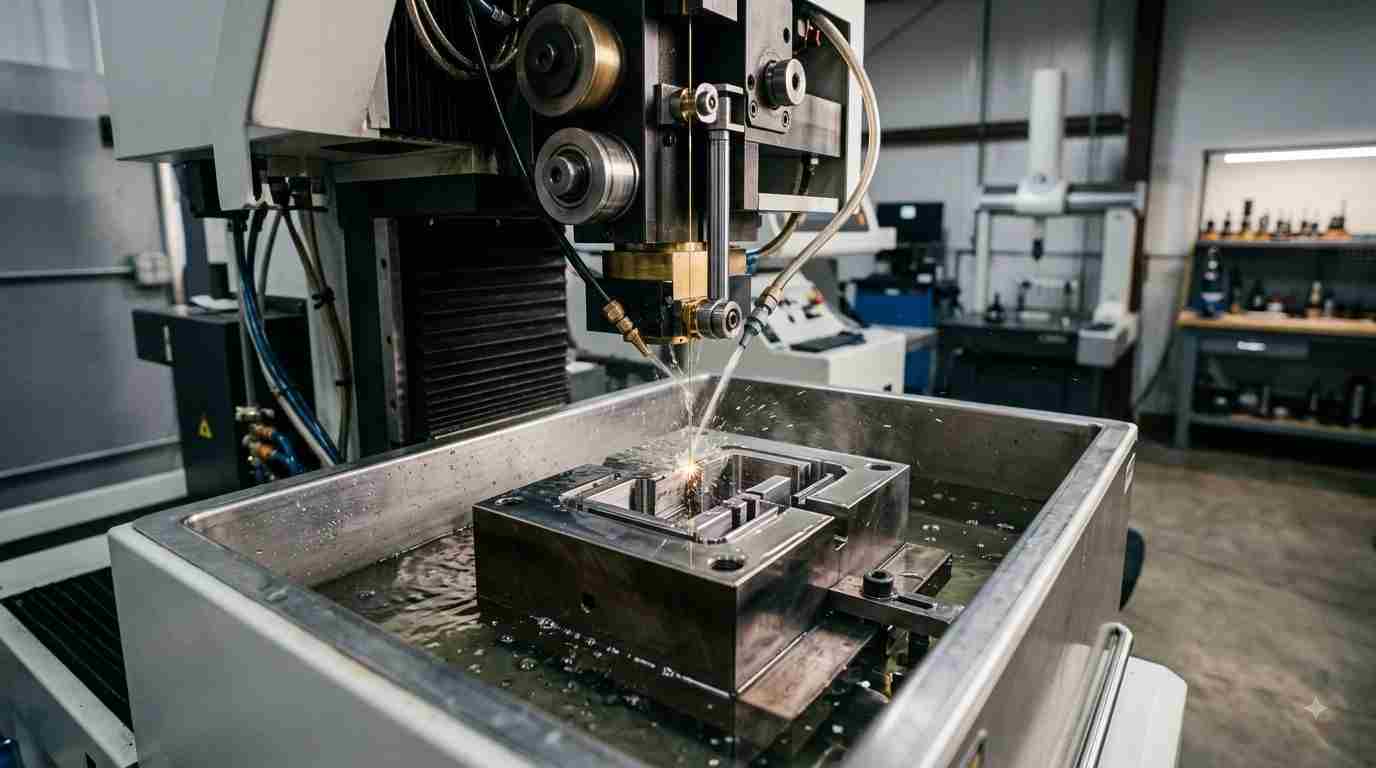
The workpiece and wire are submerged in a dielectric fluid bath (typically deionized water). As the CNC-controlled wire approaches the component, high-frequency electrical pulses generate controlled spark discharges across a microscopic gap. Each electrical spark generates localized temperatures reaching several thousand degrees Celsius, melting and vaporizing tiny particles of metal. Because the wire electrode never physically touches the workpiece, no cutting forces are exerted on the material, eliminating mechanical deflection and chatter.
Traditional machining requires cutting materials in an annealed state before heat treatment, which risks part warping during subsequent quenching and tempering. Wire EDM completely transforms this workflow:
Machining Post-Heat Treatment: Components can be fully hardened (e.g., D2, A2, H13 tool steel, or carbide) prior to Wire EDM cutting. This ensures the finished die or punch maintains absolute dimensional integrity without post-machining heat distortion.
Hardness Immunity: Wire EDM cuts materials based on electrical conductivity rather than mechanical hardness. High-density alloys like tungsten carbide, titanium, Inconel, and hardened stainless steel are cut at the same relative precision as softer metals.
Achieving mirror-like surface finishes and sub-micron accuracy requires a multi-pass cutting strategy guided by precision CNC controls:
Roughing Pass: High-energy sparks rapidly remove the bulk of the material, establishing the general geometry while leaving a small amount of stock allowance.
Skim Passes: The machine reduces spark energy and increases pulse frequency, taking successive light cuts across the boundary. Multi-pass skimming smooths out micro-craters left by the roughing pass, achieving dimensional tolerances down to ±0.001 mm and surface roughness finishes finer than Ra 0.2 µm.
Modern 4-axis and 5-axis CNC wire EDM machines feature independent X/Y and U/V axis drives. This allows the upper and lower wire guides to move independently, enabling precise taper cutting.
This capability is essential for manufacturing progressive stamping dies, extrusion dies, and injection mold inserts where draft angles and relief clearances are required to eject stamped or molded parts smoothly. Additionally, wire EDM easily creates sharp internal corners, narrow slots, and intricate keyways that are physically impossible to produce with rotating end mills.
To maintain high precision during long production runs, Wire EDM systems rely on strict environmental and operational controls:
Dielectric Filtration: Deionized water acts as an electrical insulator, a coolant, and a flushing agent. High-pressure flushing nozzles clear vaporized metal debris (swarf) from the spark gap to prevent secondary arcing.
Deionization Control: Resin beds continuously monitor and adjust the conductivity of the dielectric fluid, ensuring predictable spark energy.
Wire Tension and Alignment: Automatic wire threading (AWT) systems maintain constant physical wire tension, preventing wire bow and taper errors during deep cuts.
For specialized toolmaking, stamping die components, and high-precision inserts in demanding manufacturing sectors, partnering with a proven provider for advanced CNC wire cut EDM services for precision tooling delivers superior accuracy, minimal lead times, and flawless part geometry.