Modern manufacturing industries rely heavily on speed, consistency, and precision to meet growing production demands. Sectors such as automotive, electronics, electrical equipment, aerospace, consumer appliances, and industrial engineering require large volumes of metal components that maintain exact dimensions and uniform quality.
One of the most important technologies enabling this level of production efficiency is precision metal stamping die engineering. Advanced stamping dies allow manufacturers to shape, cut, bend, and form sheet metal into accurate components at high production speeds with minimal material waste.
With modern CNC machining, CAD/CAM software, wire EDM systems, and automated press technologies, metal stamping has become one of the most efficient and cost-effective manufacturing methods for mass production.
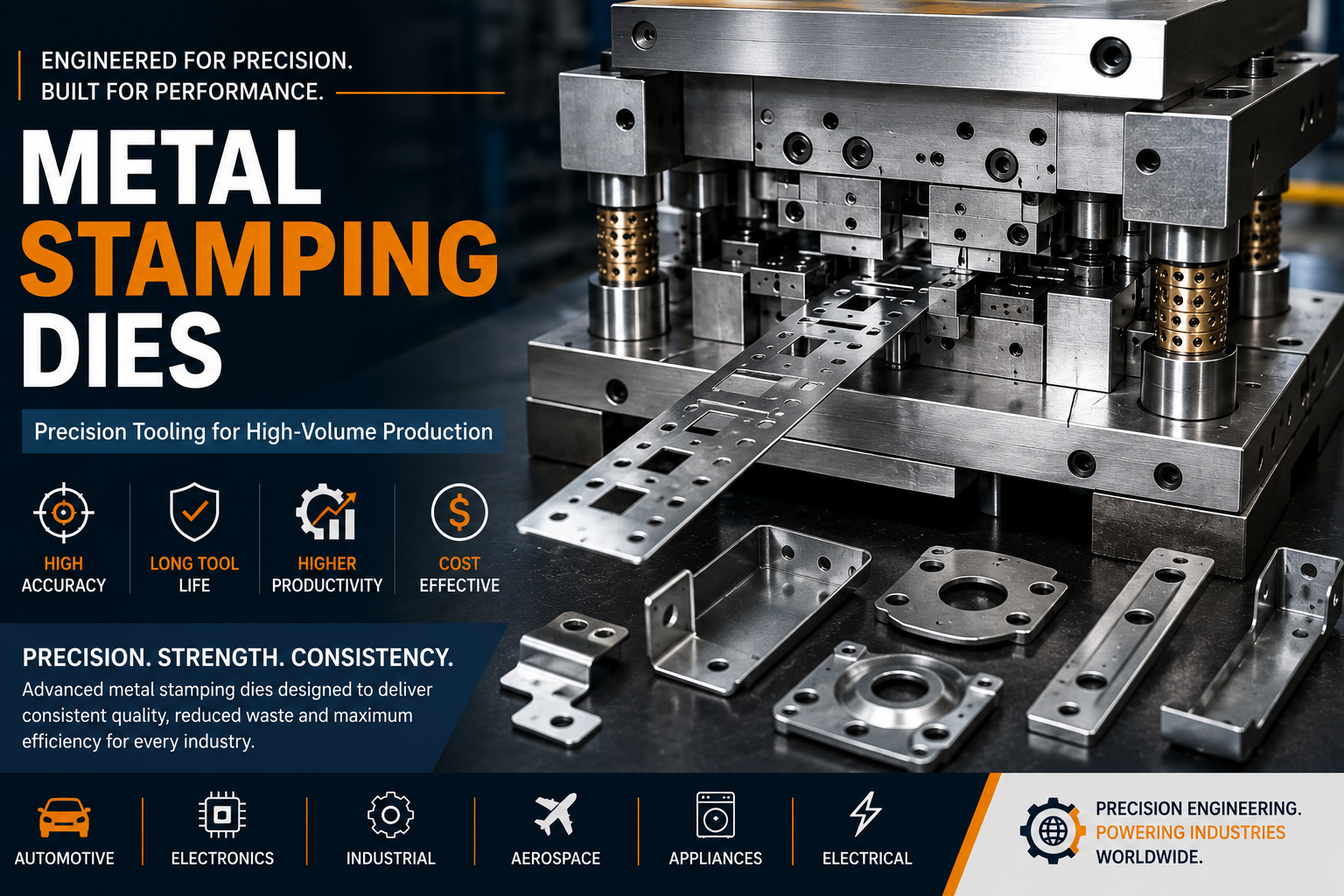
A metal stamping die is a precision-engineered tooling system used inside mechanical or hydraulic presses to transform flat sheet metal into finished or semi-finished components.
Unlike machining processes that remove material, stamping technology works through controlled mechanical deformation. The press applies high compressive force to the metal sheet, allowing the die to perform operations such as:
Blanking
Piercing
Bending
Forming
Coining
Deep drawing
This process enables rapid and repeatable manufacturing of metal parts while maintaining dimensional consistency.
The quality of a stamped component directly depends on the accuracy of the die system used during production.
Precision die engineering helps manufacturers achieve:
High dimensional accuracy
Smooth surface finish
Consistent repeatability
Faster production cycles
Reduced material waste
Better production efficiency
Modern industrial sectors require tooling systems capable of operating through millions of press strokes without losing accuracy or performance.
Well-designed dies also help reduce:
Burr formation
Tool wear
Production downtime
Material distortion
Product rejection rates
Different production requirements demand different stamping die configurations.
Single-stage dies perform one operation during each press stroke. These are commonly used for simple components and lower production volumes.
Progressive dies perform multiple operations in sequence across several stations during a single production cycle.
These dies are highly suitable for:
High-speed automation
Mass production
Complex component manufacturing
Compound dies perform several cutting operations simultaneously in a single press stroke.
Combination dies perform both cutting and forming operations together.
Transfer dies move large or complex components between multiple stations during production.
Fine blanking dies produce extremely accurate components with smooth edges and tight tolerances.
Metal stamping dies are essential across multiple industrial sectors.
Automotive manufacturers use stamping technology to produce:
Body panels
Brackets
Structural components
Mounting systems
Electrical housings
The industry requires high-volume production with exceptional consistency.
Precision stamping supports manufacturing of:
Connectors
Electrical terminals
Switch components
Shielding parts
Electronic enclosures
Aerospace manufacturers require lightweight and highly accurate metal components produced under strict quality standards.
Metal stamping dies help produce components used in:
Refrigerators
Washing machines
Air conditioning systems
Kitchen appliances
Heavy engineering sectors use stamping technology for:
Industrial brackets
Machinery parts
Equipment panels
Structural assemblies
Stamping technology supports rapid manufacturing cycles, making it ideal for high-volume production.
Precision dies ensure every component maintains identical dimensions and quality.
Large-scale production significantly lowers per-unit manufacturing costs.
Optimized die design improves material utilization and reduces scrap generation.
Manufacturers can produce millions of identical components with consistent quality.
Advanced die systems help create clean edges and smooth surfaces with minimal secondary processing.
High-quality materials and heat treatment processes increase die durability and operational life.
The performance of a stamping die largely depends on the material used during manufacturing.
Widely used for high-volume production due to excellent wear resistance.
Suitable for high-impact applications and forming operations.
Commonly used in medium-duty stamping applications.
Maintains hardness even at elevated temperatures.
Offers exceptional wear resistance and extended tool life.
Used for general-purpose stamping applications.
Selecting the correct tooling material helps improve:
Durability
Accuracy
Heat resistance
Maintenance performance
Modern stamping die production relies heavily on advanced manufacturing technologies.
Computer Numerical Control (CNC) machines provide:
High dimensional accuracy
Faster machining
Better repeatability
Complex profile creation
Wire EDM systems allow manufacturers to create intricate die shapes with extremely tight tolerances.
Benefits include:
Precise cutting
Sharp internal corners
Superior surface finish
Complex geometry manufacturing
Digital design systems help engineers optimize die performance before production begins.
This improves:
Design efficiency
Error reduction
Customization capability
Production planning
Several factors influence the performance and lifespan of stamping dies.
Higher-grade materials provide better wear resistance and longer operational life.
Proper heat treatment improves hardness and durability.
Correct clearance minimizes burr formation and improves cutting quality.
Polished and coated surfaces reduce friction and improve performance.
Regular inspection and maintenance help prevent production interruptions and premature wear.
India has developed strong capabilities in industrial tooling and stamping die engineering.
Major advantages include:
Skilled engineering professionals
Advanced manufacturing infrastructure
Competitive production costs
Strong customization capabilities
Export-oriented production
Adoption of international quality standards
Indian tooling companies now serve both domestic industries and international OEM manufacturers.
Every manufacturing process has unique production requirements.
Custom stamping dies help manufacturers optimize:
Production speed
Material utilization
Automation compatibility
Component complexity
Production consistency
Customized tooling solutions improve overall manufacturing efficiency and support scalable production.
Industrial tooling technology continues to evolve rapidly.
Key future trends include:
Smart manufacturing systems
Robotic automation
AI-assisted die design
High-speed precision machining
Advanced coating technologies
Sustainable manufacturing practices
Manufacturers adopting modern tooling innovations can achieve better productivity, lower operational costs, and improved competitiveness.
Selecting the right tooling manufacturer is critical for long-term production success.
Choose manufacturers experienced in handling:
Progressive dies
High-volume production
Complex geometries
Tight tolerance requirements
Modern machinery and inspection systems are essential for precision manufacturing.
Reliable manufacturers should provide tailored tooling solutions based on production needs.
Consistent inspection and testing ensure dependable product quality.
Timely tooling development is important for maintaining production schedules.
Technical support and maintenance assistance improve long-term operational performance.
Precision metal stamping dies play a vital role in modern industrial manufacturing by supporting high-speed, accurate, and cost-effective production of sheet metal components.
Advanced tooling technologies such as CNC machining, wire EDM systems, CAD/CAM software, and high-performance tool materials have significantly improved die quality and operational reliability.
From automotive and electronics to aerospace and industrial engineering, manufacturers increasingly depend on precision die systems to achieve consistent production quality and improved manufacturing efficiency.
Businesses investing in advanced stamping die technology benefit from lower production costs, faster manufacturing cycles, reduced waste, and long-term operational productivity.