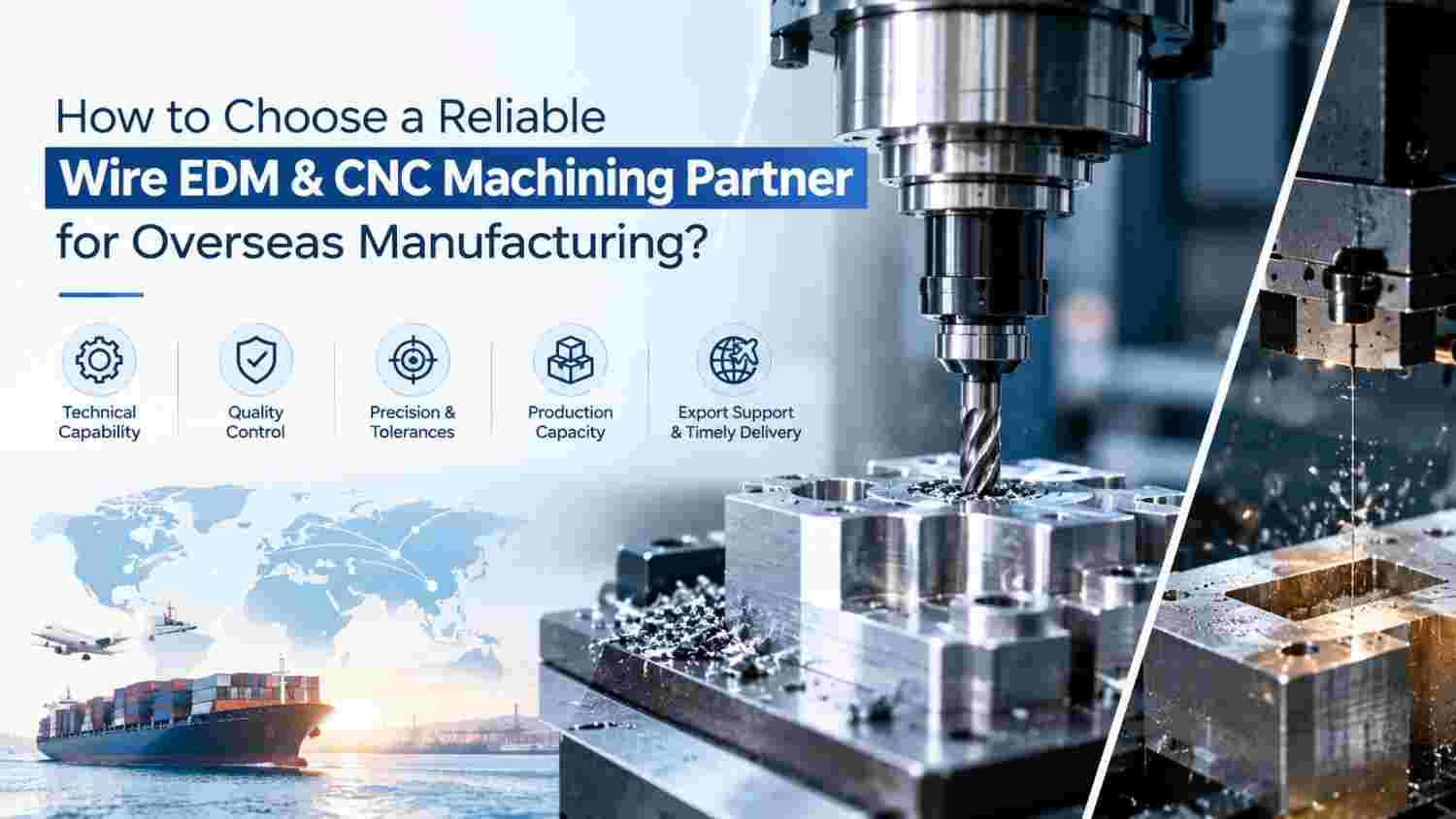
Choosing the right manufacturing partner is an important decision for companies that outsource precision components internationally. A supplier may offer an attractive quotation, but cost alone does not determine whether the partnership will be successful.
For overseas buyers in the USA, UAE, Saudi Arabia, Qatar, Kuwait, Oman, Bahrain, and other industrial markets, a reliable machining partner should be evaluated on technical capability, quality control, communication, production capacity, delivery reliability, and export support.
So, what should companies check before selecting a Wire EDM and CNC machining supplier?
The most important factor is whether the supplier can consistently manufacture components according to the drawing, specifications, tolerances, quantity, and delivery requirements.
The first step is to understand the supplier's actual manufacturing capabilities.
A supplier may advertise CNC machining, but that does not necessarily mean it has the equipment or expertise required for your specific component.
Before placing an order, check whether the manufacturer can handle:
It is also useful to understand whether multiple processes can be handled through the same manufacturing partner. Parekh Wire Cut, for example, lists CNC machining, CNC lathe machining, CNC milling, VMC machining, precision machining, and CNC Wirecut EDM among its services.
Wire EDM is particularly valuable when a component requires complex profiles, sharp internal corners, high dimensional accuracy, or machining of hardened conductive materials.
Unlike conventional milling, Wire EDM uses electrical spark erosion rather than a physical cutting tool. Because there is no direct cutting force, it can be suitable for delicate, thin, hardened, or intricate components.
Wire EDM can be useful for applications such as:
A supplier's Wire EDM capability should therefore be evaluated according to the complexity and tolerance requirements of your component.
Parekh Wire Cut states that its Wire EDM process supports complex profiles, sharp internal corners, hardened materials, and high-precision applications, with capabilities extending across tooling, moulds, automotive, aerospace, medical, defence, automation, and general engineering applications.
A supplier should be able to clearly discuss your required tolerances before production begins.
Do not simply ask whether a company offers "high precision." Instead, provide the engineering drawing and ask the supplier to identify:
A technically capable supplier should be able to review the drawing and explain which manufacturing process is appropriate.
For example, Wire EDM can be advantageous for components where conventional milling may struggle with sharp internal corners or complex profiles. Parekh's Wire EDM service information specifically compares the two processes and notes Wire EDM's ability to produce sharp internal corners and complex profiles directly from CAD data.
Yes, when practical, a prototype or first-article component can help both parties verify the manufacturing approach.
A sample provides an opportunity to check:
For new suppliers, starting with a prototype or smaller batch can also help establish confidence before moving into repeat or higher-volume production.
This is particularly useful when the component is technically complex or has strict dimensional requirements.
Quality control should be one of the primary factors in supplier evaluation.
A low-cost component is not economical if it arrives outside specification and causes production delays or rework.
A suitable supplier should have a defined process for checking manufactured components against the customer's drawings and specifications.
Depending on the project, quality checks may include:
Ask the supplier how inspection is handled and what documentation can be provided when required.
For international orders, having a clear quality-control process before shipment can significantly reduce the risk of receiving unusable components.
Yes. A supplier may be able to manufacture a prototype successfully but still struggle when the order volume increases.
Before selecting a long-term partner, understand whether the supplier can support your expected production requirements.
Ask questions such as:
Parekh Wire Cut states that it supports requirements ranging from individual prototypes to production volumes of up to 5,000 parts per month, depending on the project.
Clear communication becomes even more important when the supplier and customer are located in different countries.
Engineering drawings can contain complex information that should not be interpreted incorrectly. A reliable supplier should be willing to clarify technical questions before manufacturing begins.
Good communication should cover:
The supplier should also provide a clear process for handling drawing changes or technical issues discovered during production.
This reduces misunderstandings and helps prevent unnecessary delays.
The more complete the technical information, the easier it is for the supplier to prepare an accurate quotation and manufacturing plan.
Depending on the project, you may provide:
A good supplier should review these documents rather than simply quote a price without understanding the manufacturing requirements.
For Wire EDM work, CAD data can be especially useful because complex profiles can be programmed directly from the required geometry.
Export packaging should not be treated as an afterthought.
Precision-machined components can be affected by moisture, corrosion, impact, vibration, and improper handling during transportation.
An overseas manufacturing partner should therefore have a suitable packaging process based on the type of component and shipping method.
For international shipments, useful measures can include:
Parekh Wire Cut describes an export packaging workflow that includes moisture-proof protection, protective cushioning, plywood crating, and controlled loading for overseas transportation.
Yes, and this can be a major advantage for suitable projects.
Some components require multiple manufacturing processes. A part may need CNC milling for one section, turning for another operation, and Wire EDM for a highly accurate profile.
If these processes are handled by separate suppliers, the buyer has to coordinate:
A manufacturing partner with several complementary capabilities can simplify this workflow.
Parekh Wire Cut's service portfolio includes CNC machining, CNC turning, CNC milling, VMC machining, precision machining, and Wirecut EDM, allowing multiple machining requirements to be coordinated through one supplier.
No.
Price is important, but it should be evaluated together with quality, capability, delivery, communication, and overall project risk.
A quotation that appears cheaper may not include certain inspection requirements, finishing operations, packaging, tooling, or other project requirements.
When comparing suppliers, make sure the quotations are based on the same:
A slightly higher initial quotation may provide better overall value if it reduces rejection, rework, delays, and supplier-management problems.
Before placing an order, overseas buyers should ask practical questions about the supplier's capabilities and processes.
Some useful questions include:
The answers can help you determine whether the supplier is suitable for a long-term manufacturing relationship.
A successful overseas manufacturing relationship depends on consistency and communication.
Once a supplier demonstrates reliable quality and delivery, providing regular forecasts and clear technical documentation can help both sides plan production more efficiently.
Long-term relationships can also make it easier to:
Instead of treating every order as a separate transaction, manufacturers can work toward building a dependable supply chain.
A reliable partner should combine technical capability with consistent quality, communication, production flexibility, and dependable delivery.
For overseas buyers, the ideal supplier is not necessarily the company with the lowest price. It is the manufacturer that understands the engineering requirement, can select the appropriate machining process, maintains quality throughout production, and can deliver the finished components safely.
For complex components, having access to both CNC Machining Services and CNC Wirecut EDM Services can also simplify the manufacturing process and reduce the need to coordinate multiple suppliers.
Selecting an overseas machining partner requires more than comparing quotations. US and Gulf-region manufacturers should evaluate technical capabilities, Wire EDM expertise, CNC machining capacity, quality-control systems, communication, production scalability, packaging, and export support.
A supplier that can understand your drawings, manufacture to specification, inspect the finished components, and manage the logistics process can become much more than a machining vendor—it can become a dependable extension of your manufacturing operation.
For companies sourcing precision components internationally, the right manufacturing partnership can improve quality consistency, simplify supplier management, and support both prototype development and long-term production.