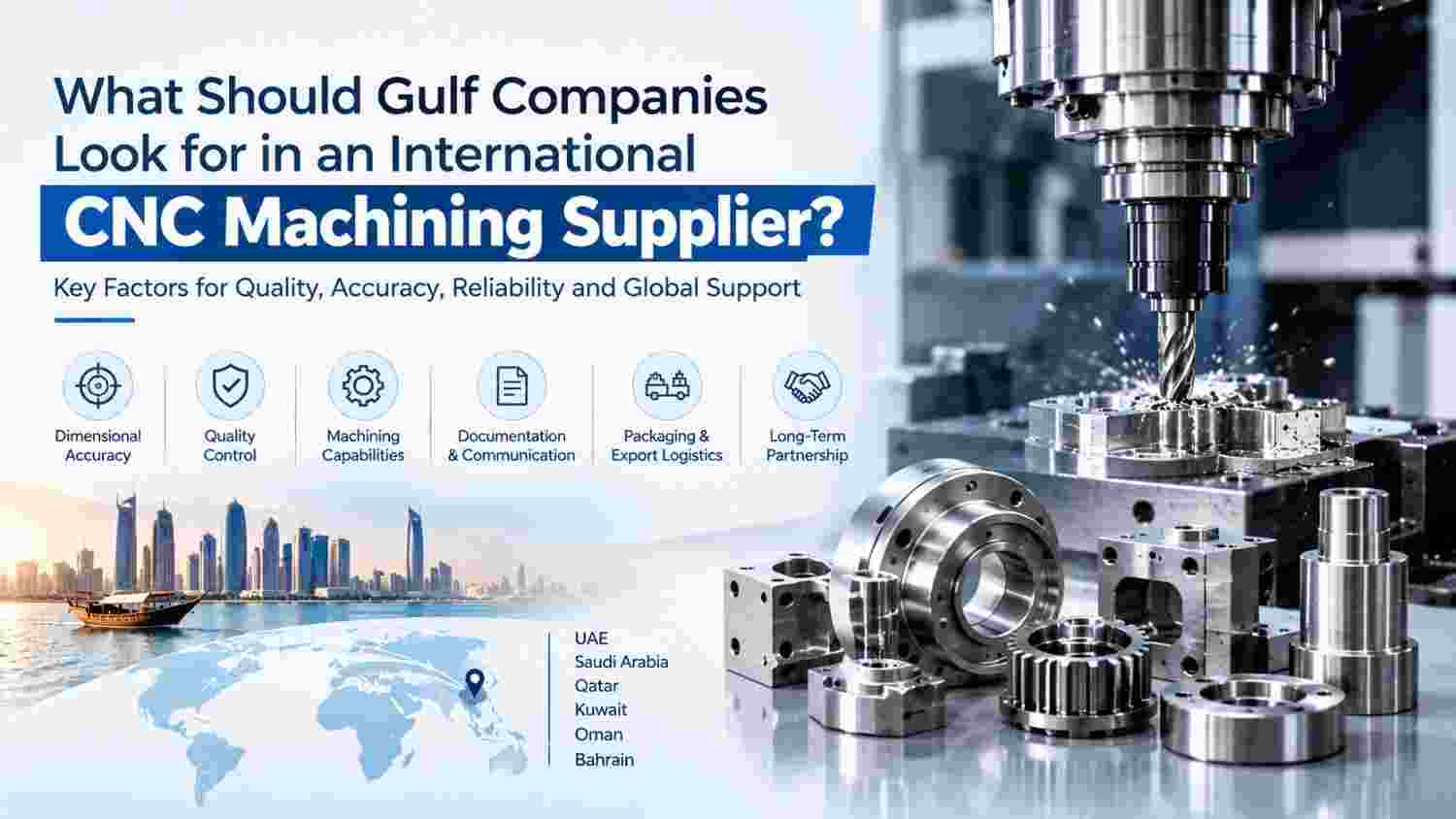
Manufacturers and engineering companies across the Gulf region often need precision components, tooling, machine parts, dies, fixtures, and other engineered products for demanding industrial applications. When these requirements are sourced internationally, selecting the right CNC machining supplier becomes an important business decision.
A supplier should offer more than competitive pricing. Gulf companies need confidence that the manufacturer can understand technical drawings, maintain dimensional accuracy, manage production requirements, provide appropriate inspection, and deliver components safely and on schedule.
Whether the requirement comes from the UAE, Saudi Arabia, Qatar, Kuwait, Oman, Bahrain, or another international market, the same basic question applies:
What should you look for in an international CNC machining supplier?
The answer starts with evaluating the supplier's technical capabilities, quality systems, communication, production capacity, and ability to manage international orders from drawing to delivery.
Gulf companies should evaluate a CNC machining supplier based on its ability to consistently manufacture components according to the required drawings, materials, tolerances, quantities, and delivery schedules.
A supplier should ideally have experience with different machining processes so that the most appropriate manufacturing method can be selected for each component.
Important factors to consider include:
It is also useful to determine whether the supplier can handle multiple manufacturing operations under one roof. This can reduce coordination between different vendors and make international sourcing easier.
Parekh Wire Cut's current service portfolio includes CNC machining, CNC milling, CNC lathe machining, precision machining, Wire Cut EDM, tooling, dies, and contract manufacturing, allowing different production requirements to be coordinated through one manufacturing partner.
Dimensional accuracy is essential when machined components need to fit with other parts or operate as part of a larger assembly.
Even a small dimensional variation can affect:
For this reason, Gulf companies should not simply ask whether a supplier provides "precision machining." They should discuss the actual tolerances required for the component.
A good supplier should be able to review the engineering drawing and identify critical dimensions, tolerance requirements, surface finishes, and features that may require specialized machining.
This is particularly important for tooling, dies, mould components, machine parts, automation components, and other precision applications.
Yes. Indian manufacturers can supply CNC-machined components and other engineered products to international customers when they have the appropriate manufacturing, inspection, packaging, and export processes in place.
For a Gulf buyer, the important consideration is not simply where the supplier is located. The focus should be on whether the supplier can consistently meet the technical and commercial requirements of the project.
An international CNC machining supplier should be able to manage the process from receiving drawings and specifications through manufacturing, inspection, packaging, and dispatch.
This approach can allow Gulf companies to access specialized manufacturing capabilities without having to invest in every machining process internally.
Parekh Wire Cut operates its manufacturing facilities in India and states that it supplies precision engineering and CNC machining solutions to international markets. Its website also lists Gulf markets among its international market areas.
Providing complete technical documentation is one of the easiest ways to reduce manufacturing misunderstandings.
Depending on the component, Gulf buyers may need to provide:
The drawing should clearly identify critical dimensions and any special manufacturing requirements.
When a 3D model is available, it can help the supplier understand complex geometry. A 2D drawing remains important because it typically defines dimensions, tolerances, materials, surface finishes, and other manufacturing requirements.
For Wire EDM projects, CAD or profile data can be particularly useful because the cutting path can be developed from the required geometry.
International manufacturing becomes easier when responsibilities and requirements are clearly defined before production begins.
A good workflow starts with sharing the technical drawing and requesting a detailed quotation. The supplier should then review the requirements, clarify any technical questions, confirm the manufacturing process, and provide an estimated production schedule.
Once the order is approved, the buyer and supplier should maintain clear communication regarding:
This becomes particularly important when the component is part of a larger production schedule.
A reliable supplier should not wait until the end of production to communicate a problem. Technical issues, material concerns, or drawing inconsistencies should be discussed as early as possible.
Quality should be evaluated before the first production order is placed.
A supplier may have modern CNC machines, but the manufacturing process also depends on programming, tooling, setup, operator expertise, process control, and inspection.
Ask the supplier how finished components are checked against the drawing.
Depending on the component, inspection may include:
The objective is not to create unnecessary inspection requirements. Instead, the inspection process should match the functional importance and precision requirements of the component.
Parekh Wire Cut states that its international manufacturing workflow includes machining and inspection before components are packed and dispatched.
CNC machining can support a wide range of industries because the process can be adapted to different component geometries, materials, quantities, and applications.
Industries that may outsource CNC machining include:
The exact requirements will vary by industry.
For example, a tooling company may require complex Wire EDM profiles, while a machinery manufacturer may need shafts, housings, brackets, flanges, or other CNC-machined components.
The important consideration is whether the supplier has experience with the type of component and manufacturing process required.
Parekh Wire Cut lists automotive, aerospace, defence, industrial automation, electrical and electronics, medical equipment, packaging machinery, textile machinery, tool and die, and general engineering among the sectors it serves.
Packaging becomes particularly important when precision components travel long distances.
Machined components may be exposed to vibration, impact, dust, moisture, and changes in environmental conditions during transportation. Poor packaging can result in scratches, corrosion, deformation, or other damage even when the component was manufactured correctly.
An international supplier should therefore have a defined packaging and dispatch process.
Depending on the product, suitable protection may include:
For Gulf-bound shipments, protection from humidity and dust can be particularly relevant.
Parekh Wire Cut describes moisture-proof inner protection, cushioning, reinforced plywood crating, and controlled loading as part of its international logistics approach for precision products.
In many cases, yes.
Some components require more than one manufacturing process. A part may require CNC milling for one operation and Wire EDM for another highly intricate profile.
Working with separate suppliers for each process can increase:
A supplier offering both CNC machining and Wire EDM can simplify the workflow for projects requiring multiple processes.
Wire EDM is especially useful for intricate profiles, narrow slots, sharp internal corners, hardened materials, and components where conventional cutting may not provide the required result.
At the same time, CNC milling and turning remain important for producing a wide range of standard and complex industrial components.
Having access to both processes can therefore give buyers greater manufacturing flexibility.
A supplier should be capable of supporting the expected quantity throughout the life of the project.
A manufacturer may successfully produce a prototype but struggle when the requirement increases to hundreds or thousands of components.
Before selecting a supplier, discuss:
A supplier with scalable production capabilities can make it easier to move from prototype development to regular manufacturing.
Parekh Wire Cut states that it supports requirements ranging from individual prototypes to production volumes of up to 5,000 parts per month, depending on the project.
The lowest quoted price should not be the only factor when comparing international suppliers.
The actual cost of sourcing a component can include:
A supplier offering a slightly higher manufacturing price may provide better overall value if it delivers consistent quality, reliable lead times, appropriate packaging, and fewer rejected components.
For this reason, Gulf companies should compare quotations based on the complete scope of supply rather than only the price per component.
Technical communication is one of the most important parts of successful international manufacturing.
Different interpretations of a drawing or specification can result in incorrect components. A good supplier should ask questions whenever a requirement is unclear instead of making assumptions.
Communication should cover:
A supplier that communicates clearly can help identify potential manufacturing problems before they become expensive production issues.
This is especially valuable for companies outsourcing precision components for the first time.
Yes. Contract manufacturing can allow companies to outsource selected production requirements instead of maintaining every manufacturing process internally.
A contract manufacturing partner can potentially manage several stages of the production process, including material sourcing, machining, inspection, packing, and dispatch.
This can be useful for companies that need:
Parekh Wire Cut describes its contract manufacturing workflow as covering material sourcing, machining, inspection, packing, and dispatch, allowing customers to provide drawings and production requirements while the supplier manages the manufacturing process.
Before placing an international order, procurement and engineering teams should ask practical questions about the supplier's capabilities.
Some useful questions include:
The answers can help buyers distinguish between a supplier that simply accepts orders and a manufacturing partner capable of supporting long-term requirements.
A good international CNC machining supplier combines technical capability, quality consistency, communication, production flexibility, and dependable delivery.
For Gulf companies, the ideal partner should be able to understand engineering requirements, recommend suitable manufacturing processes, maintain required tolerances, inspect finished components, and package products appropriately for international transportation.
Access to complementary capabilities such as CNC Machining Services, CNC Wirecut EDM Services, CNC Milling Services, CNC Lathe Machining Services, and Contract Manufacturing can make the sourcing process more efficient.
Choosing an international CNC machining supplier is an important decision for Gulf companies that depend on accurate, reliable, and consistently manufactured components.
The right supplier should not be selected on price alone. Technical expertise, dimensional accuracy, quality control, production capacity, communication, documentation, packaging, and export logistics all contribute to the success of an international manufacturing relationship.
For companies in the UAE, Saudi Arabia, Qatar, Kuwait, Oman, Bahrain, and other industrial markets, working with a capable manufacturing partner can provide access to advanced machining and production expertise without requiring every process to be maintained in-house.
The best supplier is ultimately the one that understands your drawings, respects your specifications, communicates clearly, maintains consistent quality, and can support your requirements from the first prototype through ongoing production.