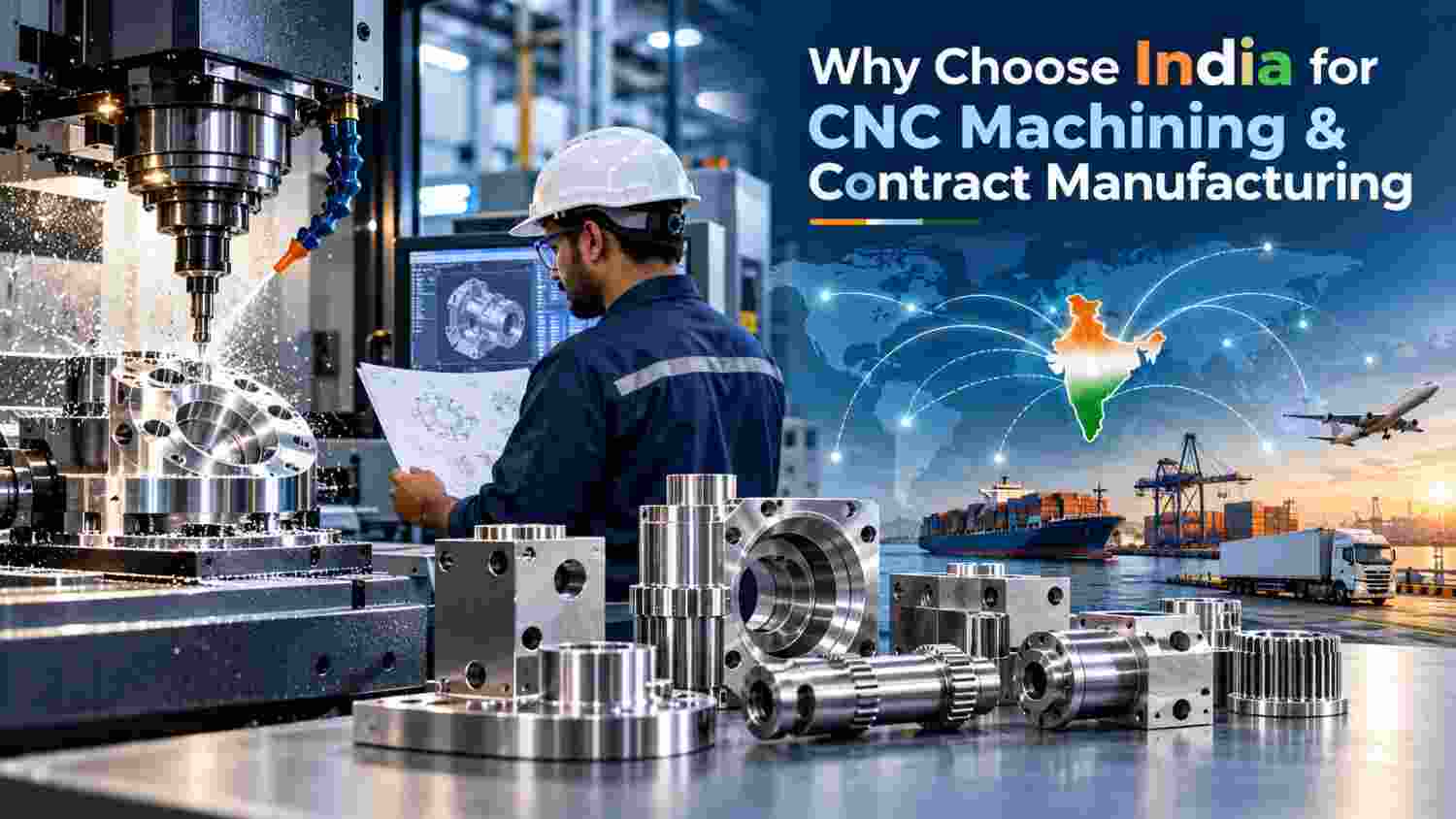
Manufacturers around the world are looking for reliable ways to produce precision components while maintaining quality, controlling production costs, and meeting delivery schedules. For many companies, outsourcing selected manufacturing requirements has become an important part of their supply-chain strategy.
India has developed a strong manufacturing ecosystem covering CNC machining, precision engineering, tooling, dies, fabrication, component manufacturing, and contract production. This makes India an option worth considering for companies looking for an international manufacturing partner.
But why should an overseas company choose India for CNC machining and contract manufacturing?
The answer is not simply lower manufacturing costs. The real value comes from combining engineering capabilities, skilled manufacturing resources, production flexibility, and the ability to support different types of industrial requirements.
India has a large engineering and manufacturing sector with experience across a wide range of industrial applications.
CNC machining is used to manufacture components for industries such as:
For international buyers, this broad manufacturing ecosystem can make it easier to find suppliers capable of handling both standard and specialized components.
Instead of treating CNC machining simply as a production process, overseas companies can work with Indian manufacturers for engineering support, component manufacturing, tooling, inspection, and repeat production.
Cost efficiency is one of the reasons companies consider international manufacturing, but the objective should be to achieve the right balance between cost and quality.
The total cost of a machined component depends on several factors, including:
Indian manufacturing can provide an opportunity to optimize these costs through efficient production and access to an established engineering supply chain.
However, overseas buyers should not select a supplier based only on the lowest quotation. A reliable manufacturer should be evaluated on quality consistency, technical capability, communication, production capacity, and delivery performance as well.
Yes. Indian manufacturers can produce precision components according to customer drawings, CAD models, material specifications, tolerances, and inspection requirements.
The important factor is the capability of the individual manufacturing company.
Before placing an order, overseas buyers should confirm that the supplier can meet the required specifications and has suitable equipment, processes, and inspection procedures.
Precision manufacturing may involve CNC milling, CNC turning, VMC machining, Wire EDM, tooling, dies, and other specialized processes depending on the component.
A supplier with multiple complementary capabilities can also simplify production when a component requires more than one machining process.
The exact capabilities vary from one manufacturer to another, but Indian CNC machining companies can support a broad range of production requirements.
These may include:
For complex profiles, CNC Wirecut EDM Services can be particularly useful because Wire EDM can produce intricate profiles, narrow slots, sharp internal corners, and accurate shapes in electrically conductive materials.
For general component manufacturing, CNC Machining Services can provide an efficient solution for producing parts according to engineering drawings and production requirements.
Contract manufacturing allows a company to outsource selected manufacturing activities to a specialized production partner.
Instead of purchasing every machine, hiring operators, arranging tooling, managing maintenance, and developing every manufacturing process internally, an overseas company can work with a contract manufacturer for specific components or production programs.
This can be useful for:
A suitable Contract Manufacturing partner can potentially manage several stages of the production process, from material sourcing and machining to inspection, packaging, and dispatch.
This can make international sourcing more convenient for companies that do not have their own manufacturing infrastructure in India.
Many manufacturing projects start with a prototype before moving into regular production.
The supplier therefore needs to understand that prototype manufacturing and production manufacturing have different requirements.
A prototype may be used to verify:
Once the design is approved, production quantities may increase significantly.
For this reason, overseas buyers should look for a supplier that can support the project as it moves from prototype to repeat manufacturing.
A supplier with flexible production capacity can help reduce the need to change vendors as the project develops.
Engineering communication can make a major difference to the success of an outsourced manufacturing project.
A supplier should be able to review drawings and identify potential manufacturing issues before production begins.
For example, the manufacturer may identify:
This does not mean changing the customer's design without approval. Instead, the supplier can highlight manufacturing considerations so that the buyer can make informed decisions.
Good engineering communication can help reduce rework, production delays, and unexpected costs.
Yes. Indian manufacturers can serve international customers when they have the appropriate export and production systems.
For buyers in the USA, UAE, Saudi Arabia, Qatar, Kuwait, Oman, Bahrain, and other markets, the supplier's ability to manage international orders is an important consideration.
A complete international manufacturing workflow may include:
The buyer should discuss these requirements with the supplier before confirming the order.
Accurate documentation helps the manufacturer understand exactly what needs to be produced.
Depending on the project, buyers should provide:
If drawings are revised, the latest revision should always be clearly identified.
Clear documentation helps reduce the possibility of manufacturing the wrong version of a component.
CNC milling is one of the most versatile machining processes for producing components with slots, pockets, holes, contours, faces, and other complex features.
It can be used for producing:
Companies outsourcing components to India should evaluate whether the supplier has the appropriate CNC milling equipment and experience for the required geometry.
CNC Milling Services can be especially useful when components require multiple machining operations within a controlled production process.
CNC turning is commonly used for components with cylindrical or rotational features.
Typical applications include:
When a supplier provides both turning and milling capabilities, it may be possible to manufacture different component types through the same production partner.
This can simplify procurement and supplier management for overseas companies with multiple machining requirements.
International sourcing should never be based on cost alone.
A component that does not meet its drawing requirements can create additional expenses through:
Quality control should therefore be discussed before production begins.
Depending on the component, inspection may include checking:
Overseas buyers should also clarify whether inspection reports or other quality documentation are required before shipment.
Clear and consistent communication is essential for successful international manufacturing.
Before production, both parties should agree on:
A defined communication process can reduce confusion and help identify technical issues early.
For repeat orders, maintaining approved drawings, specifications, and production information can also make future procurement more efficient.
India can be considered for both individual component requirements and longer-term manufacturing programs, provided the selected supplier has the required capacity and quality systems.
A long-term manufacturing relationship can offer several advantages.
Once a component has been successfully produced and approved, future orders can follow an established manufacturing process.
This can make it easier to:
The key is to select a manufacturing partner capable of growing with the buyer's requirements.
Overseas companies should evaluate a potential supplier using a combination of technical and commercial criteria.
Important questions include:
Requesting a sample or starting with a smaller project can also help establish confidence before moving into larger production programs.
For international buyers, the potential benefits include access to an established engineering ecosystem, flexible production capabilities, specialized machining processes, contract manufacturing support, and competitive manufacturing economics.
However, the supplier remains the most important factor.
A capable manufacturer can help an overseas company move from drawings and prototypes to approved production components while maintaining the required quality and specifications.
The goal should therefore be to find the right Indian manufacturing partner rather than simply finding the cheapest supplier.
India can be a practical manufacturing destination for companies looking to outsource CNC machining, precision components, tooling, and contract manufacturing.
For buyers in the USA, Gulf countries, and other international markets, the biggest advantage is the ability to access a broad manufacturing ecosystem while working with suppliers that can support different stages of production.
However, successful international sourcing depends on choosing the right partner.
Technical capability, dimensional accuracy, quality control, production capacity, engineering communication, documentation, packaging, and export support should all be evaluated before placing an order.
When these factors are properly managed, an Indian CNC machining and contract manufacturing partner can become a reliable extension of an overseas company's manufacturing supply chain.